
Many visitors ask where the Great Wall starts and ends, but the clean map answer is harder than it first sounds. The Great Wall was not built as one single line by one dynasty. It is a long historical system of walls, passes, trenches, beacon towers, mountain barriers, and frontier defenses built and rebuilt over centuries. That is why different sources may name Jiayuguan, Shanhaiguan, Laolongtou, or other frontier points depending on which wall system they are describing.
Quick Answer: Where Does the Great Wall Start and End?
For the famous Ming-era Great Wall, a common west-to-east answer is: it begins around Jiayuguan Pass in Gansu and reaches the sea at Laolongtou near Shanhaiguan in Hebei. For the full historical Great Wall system, the answer is broader because earlier and later wall lines extended across different regions and dynasties.
| Question | Short answer | Why it can vary |
|---|---|---|
| Where does the Great Wall start? | Jiayuguan is the best-known western starting point for the Ming Great Wall. | Other older wall systems had different western and northern frontier lines. |
| Where does the Great Wall end? | Laolongtou near Shanhaiguan is the famous eastern end where the wall meets the Bohai Sea. | Maps may count different branches, ruins, and dynasty systems. |
| Is it one continuous wall? | No. It is a network, not one unbroken walkway. | This is why the Great Wall length is explained as a full system. |
Why Jiayuguan Is Called the Western Starting Point
Jiayuguan Pass is often called the western starting point of the Great Wall because it was a major Ming Dynasty frontier fortress on the edge of the Hexi Corridor. It was not just a wall section; it was a strategic gate, military checkpoint, and symbolic boundary between the settled frontier and routes leading west.
For travelers, Jiayuguan is useful because it gives the Great Wall a strong western landmark. It helps answer the map question, even though the total historical wall system is more complex than a single start point.
Why Shanhaiguan and Laolongtou Are Called the Eastern End
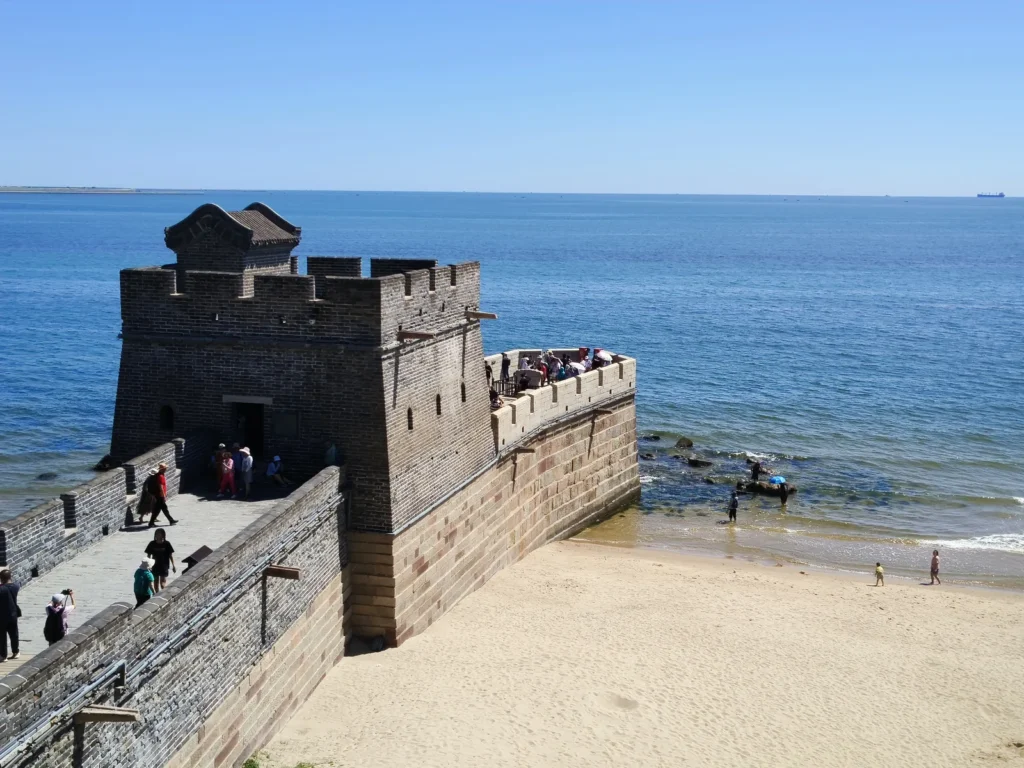
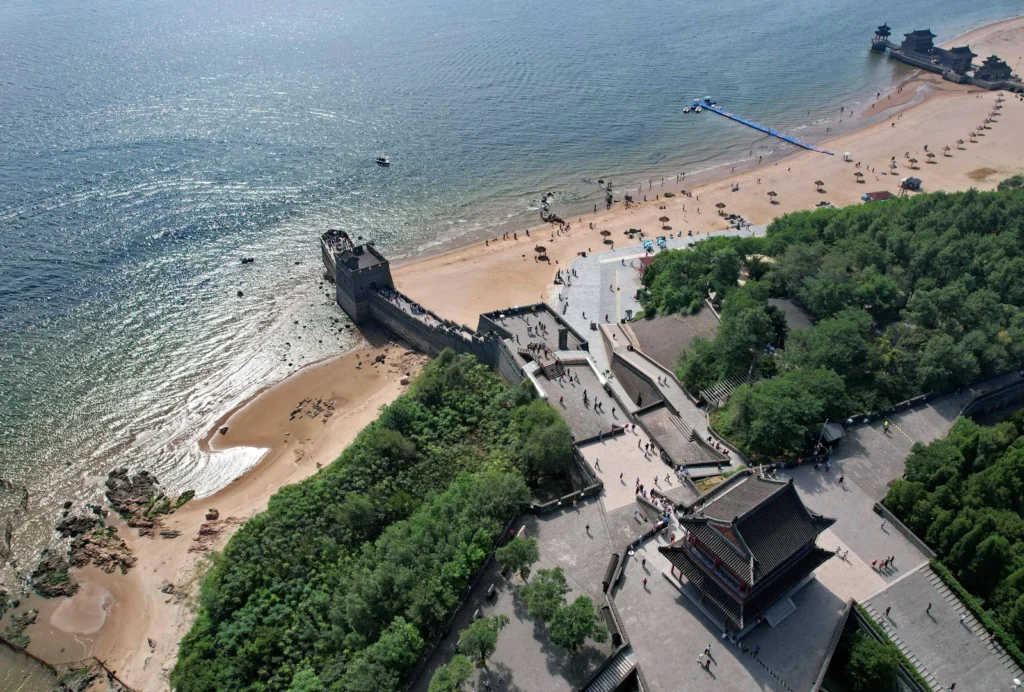
Shanhaiguan and Laolongtou are usually used for the eastern-end answer. Shanhaiguan was one of the most important passes of the Ming Great Wall. Laolongtou, meaning “Old Dragon’s Head,” is the coastal section where the wall appears to run into the sea.
Why Some Answers Are Different
Different answers appear because people use the phrase “Great Wall” in different ways. A school report may mean the famous Ming wall. A history book may include walls from Qin, Han, Northern Wei, Jin, Ming, and other periods. A travel map may focus only on restored visitor sections near Beijing.
| Type of answer | What it usually means | Best page to read next |
|---|---|---|
| Simple travel answer | Jiayuguan in the west, Shanhaiguan/Laolongtou in the east. | Laolongtou and Shanhaiguan guide |
| Length answer | The full system includes branches, trenches, and remains. | How long is the Great Wall? |
| History answer | Different dynasties built different frontier systems. | Great Wall history |
| Early-wall answer | Older walls existed before the famous Ming sections. | The earliest Great Wall |
What This Means for Travelers
Most Beijing visitors do not need to visit either endpoint to understand the Great Wall. If your trip is short, it is more practical to choose a Beijing-area section such as Mutianyu, Badaling, Jinshanling, or Simatai. The endpoint question is more useful when you want historical context, a map-based answer, or a longer China itinerary that reaches Gansu or the Bohai coast.
If you are planning a first Great Wall visit, start with Great Wall sections near Beijing. If you are researching facts, continue with the Great Wall facts and myths hub.
FAQ
Does the Great Wall start at Jiayuguan?
For the famous Ming Great Wall, Jiayuguan is the best-known western starting point. For the full historical Great Wall system, the answer is broader because earlier walls had different routes.
Does the Great Wall end in the sea?
The famous sea-end image comes from Laolongtou near Shanhaiguan, where the Ming Great Wall reaches the Bohai Sea. It is one of the clearest visual endpoint answers.
Can you walk from one end of the Great Wall to the other?
No, not as a normal travel activity. The wall is not one continuous maintained path. Many parts are ruins, restricted areas, remote frontier remains, or separated historical lines.
Which endpoint is easier to visit?
Shanhaiguan and Laolongtou are more realistic for travelers already going toward Qinhuangdao or the Bohai coast. Jiayuguan is far away in Gansu and fits a different northwest China itinerary.