
“Gubeikou” and “Gubei Water Town” sound close enough to be mistaken for two names for the same place. They are not. Gubeikou Village (古北口村) is an older settlement associated with a historic pass and nearby Great Wall ridges. Gubei Water Town (古北水镇, also called Beijing WTown) is a managed visitor resort beside the Simatai Great Wall. Both are in the wider Gubeikou area of Beijing’s Miyun District, but they call for different tickets, drop-off points and expectations.
That distinction matters before you hire a driver, book a guesthouse or tell friends you are “going to Gubeikou.” A booking for the Water Town does not automatically put you at the village gate or on a Gubeikou wall hike. Equally, a room in the village should not be assumed to include resort entry or a view of Simatai. Use this guide to choose the place you actually want, then verify current opening and transport details with the operator or your host.
The short answer: two destinations, one confusing name
Beijing’s culture and tourism bureau describes Gubeikou Village as lying between the Wohushan and Panlongshan mountains, with the Chao River through the area. The same official route names the village and Gubei Water Town as separate stops. The municipal Water Town resort listing gives the latter an address in Simatai Village, Gubeikou Town, and connects the resort to Simatai Great Wall. The administrative town name is the source of much of the confusion: being in Gubeikou Town does not make the resort the same place as Gubeikou Village.
Think of the choice this way. Gubeikou Village is the place for a quieter settlement-and-frontier landscape, with nearby wall walking only when you have a suitable, permitted route. Gubei Water Town is the place for canal-side streets, restaurants and a more organized Simatai visit. Neither is automatically “better”; the right answer depends on whether you want an older village and rugged wall context or a resort base and managed sightseeing.
What Gubeikou Village actually feels like
Start with the gate and village streets, not a promise that every part of the nearby Great Wall can be casually climbed. The physical setting is the point: an old passage through mountains, a living community and wall lines on surrounding ridges. You may see ordinary shops, local homes and traffic rather than a polished attraction sequence. Treat that as a feature of a real village, not a failure to provide a “water town” experience.
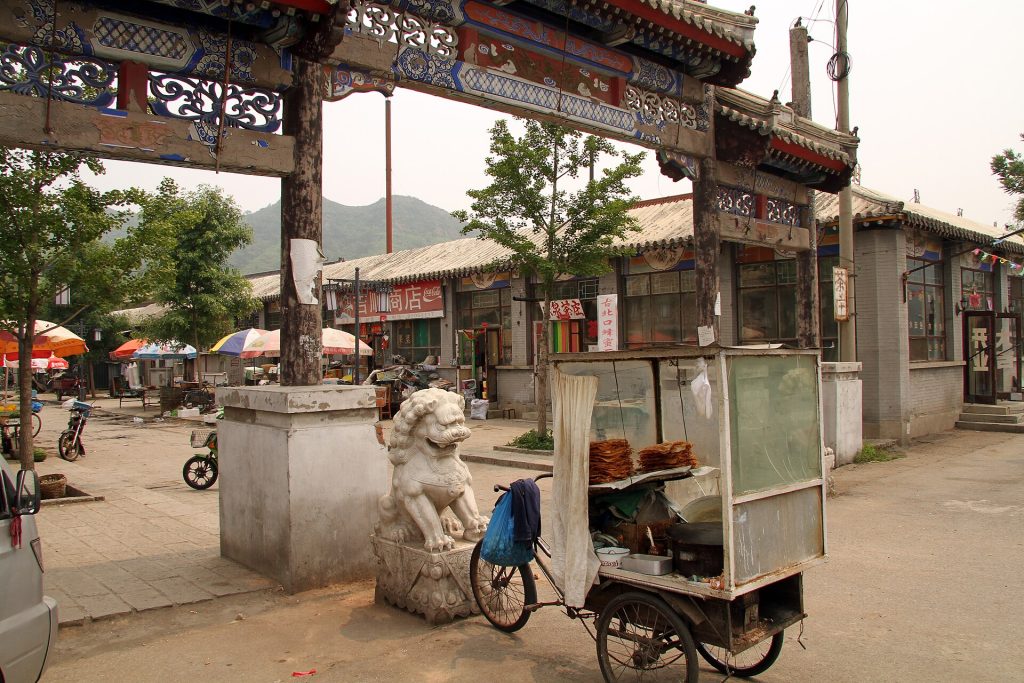
For travelers interested in fortification history, the nearby Panlongshan and Wohushan areas make the landscape more legible. Beijing’s official Panlong Mountain introduction places this Great Wall in the Gubeikou area. Do not infer from a photograph that an informal trail, tower or traverse is open and safe today. Sections can be uneven or unmaintained, and access rules can change. Choose an open route and turn back if the surface, weather or signage does not support your plan.
The village can be an excellent slow stop without committing to an exposed ridge walk. Allow time to look at the gate, move through public streets respectfully and take in the surrounding topography. Ask before photographing people or private courtyards. If you want a longer hike toward Jinshanling, read our separate Gubeikou-to-Jinshanling route guide; do not treat that demanding traverse as an add-on to a casual village visit.
What Gubei Water Town actually offers
The Water Town is a resort experience. Its canals, bridges, accommodation and food options are arranged for visitors, and Simatai is the adjacent Great Wall attraction. An official Beijing travel feature places the Water Town at the foot of Simatai and describes its reconstructed bridges and retro-style buildings. That is different from saying it is Gubeikou’s old village preserved unchanged. Come for the managed experience, and describe it honestly.
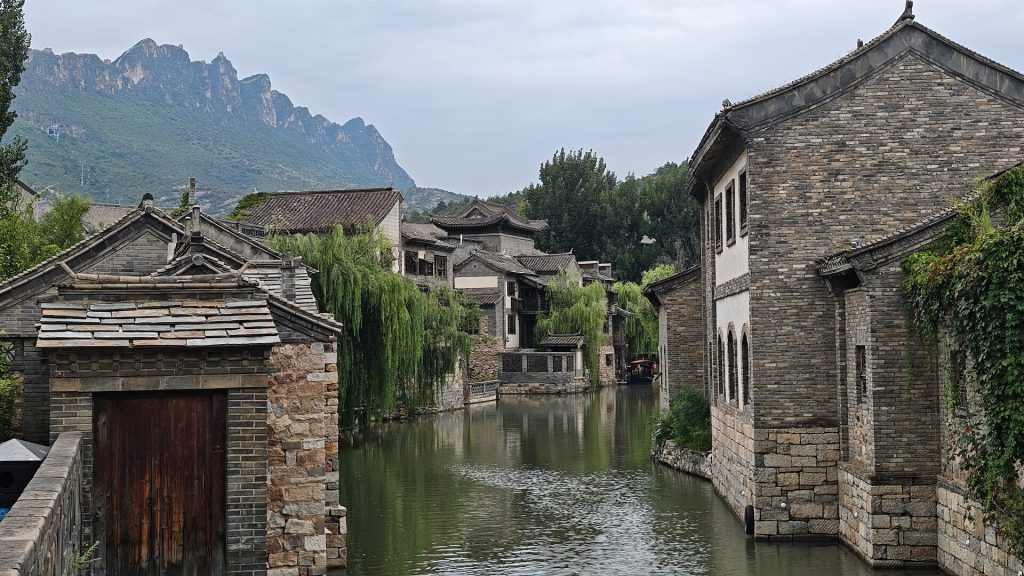
Simatai is the wall choice linked to the resort. Its ticket, access window and possible evening programme are decisions to check separately, not benefits you can assume from having a Water Town entry or hotel booking. If a night walk is the main reason for your trip, confirm the date and route before paying for transport or lodging; our Simatai night-tour guide covers the planning trade-offs. It is possible to enjoy the resort without climbing the wall, but then be clear that the water-town visit is the primary experience.
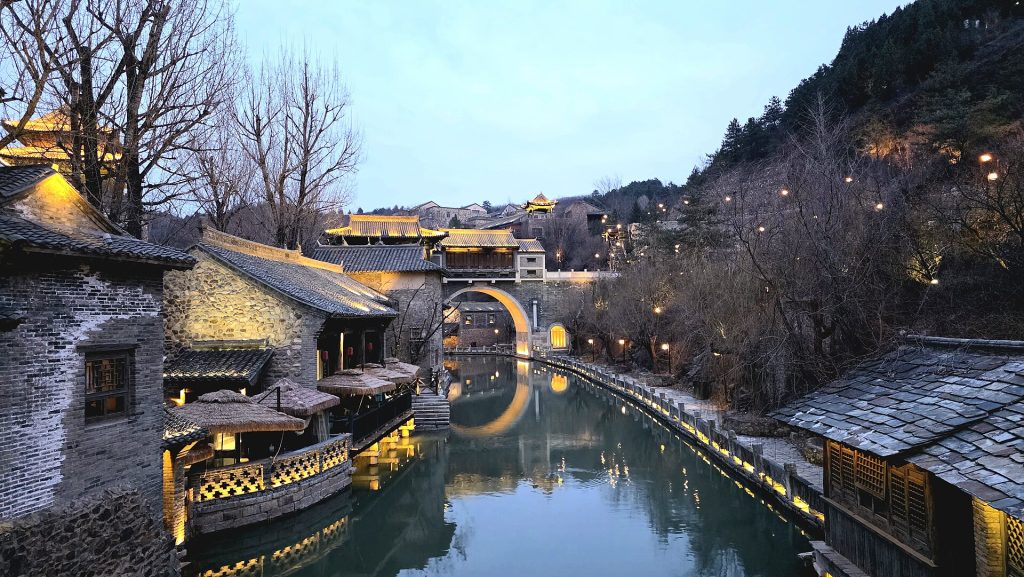
For an overnight trip, staying within or near the resort may make evening activities easier. Confirm whether your room rate includes resort entry, whether the hotel is inside or outside the controlled area, and how late you can re-enter. The exact commercial arrangements may change. A generic listing saying “Gubeikou” is not enough: request a map pin and the hotel’s Chinese address.
Which place should you choose?
Choose Gubeikou Village if the attraction is the old frontier setting, ordinary village life and a considered walk near less-restored Great Wall terrain. It suits travelers comfortable with a less packaged stop, but it is not the easy option for someone expecting a broad, maintained wall promenade. A local guide or a carefully confirmed route is sensible for any substantial hike.
Choose Gubei Water Town if you want a clearly organized arrival, accommodation and dining choices, picturesque canals, and the option of a separately planned Simatai visit. It is particularly practical when one person wants the wall and others prefer an easier resort day. The trade-off is that it is a commercial visitor complex, not a substitute for the older Gubeikou settlement.
Choose both only when you have enough time to make two deliberate stops. A full day with a driver or an overnight itinerary can work better than trying to squeeze a village walk, a rugged hike, a resort visit and a Simatai night tour into one short outing. The two places are not simply opposite ends of one pedestrian attraction. A driver should have both destinations pinned and know which one you visit first.
A realistic plan from Beijing
For a village-focused day, set the destination as 古北口村, confirm the exact parking or meeting point with your driver, and leave the wall walk optional until you have checked current access and conditions. Ask your host or guide whether the particular area you hope to see is open. Allow a flexible return time; the experience loses its value if you are forced to rush straight from car to ridge and back.
For a Water Town and Simatai day, set the destination as 古北水镇 or the resort’s current official entrance, not merely “Gubeikou.” Verify the resort and Great Wall tickets separately. If you plan to visit Simatai after dark, check the current operating calendar and last entry; an older online schedule is not enough. Our Beijing-to-Simatai guide provides the transport context, while the operator should be the final source for today’s opening rules.
For a two-stop day, tell the driver in writing: “Gubeikou Village (古北口村), then Gubei Water Town (古北水镇) entrance.” Confirm the extra transfer and waiting charges before departure. If traveling independently, check each leg and the return trip as a separate journey; do not assume that a route to the resort stops conveniently at the village or that an evening bus back to Beijing will suit your finish time.
Booking checks that prevent the common mistake
- Map pin: ask for the entrance or hotel pin, not just the word “Gubeikou.”
- Chinese name: use 古北口村 for the village and 古北水镇 for the resort.
- Great Wall section: ask whether your plan is for Gubeikou’s nearby wall terrain or for Simatai beside the resort.
- Tickets: verify resort entry, Simatai entry and any evening programme as separate items.
- Hotel: confirm whether it is in the old village, inside the Water Town, or somewhere else in Gubeikou Town.
- Return: agree on pickup point and time before anyone walks away from the vehicle.
Beijing’s municipal tourism office has even published a route combining the ancient imperial road, Water Town and Simatai as distinct stops. That is the useful mental model: this is a region with several experiences, not a single attraction with multiple English names. Pick the experience first; then book the precise place that delivers it.
The photos in this article are real scenes from the village and resort, credited to their creators. They show what those places looked like when photographed, not guaranteed current access, shop openings or night-tour schedules. Check live operating information before committing money to the trip.
Featured photo: Sgnpkd / Wikimedia Commons, CC BY-SA 4.0. Resized; archive thumbnails may be cropped. These real photographs illustrate the locations, not current access, crowd levels, or weather.