
A Beijing airport layover can be enough for Mutianyu Great Wall, but only for the right traveler and the right connection. If your goal is a calm, scenic Great Wall experience between flights, Mutianyu is usually more practical than remote hiking sections and more comfortable than trying to combine too many Beijing sights. If your layover is short, your onward flight is international, or immigration takes longer than expected, staying near the airport is the smarter choice.
This guide is written for foreign visitors arriving through Beijing Capital International Airport (PEK) or Beijing Daxing International Airport (PKX) who are considering a same-day Great Wall visit. It does not replace official immigration, airline, airport, or scenic-area rules. Always check official channels before visiting, especially during holidays, winter weather, flight delays, or policy changes.
Quick planning snapshot
| Best for | Travelers with a long Beijing layover who want one memorable Great Wall stop, not a rushed city tour |
| Best airport | PEK is usually more practical for Mutianyu than PKX because it sits on the northeast side of Beijing |
| Minimum comfort zone | A full-day or very long layover is the safer target; short connections are not worth the risk |
| Transport style | Private car or prearranged transfer is the most realistic choice; public transport is too slow for most layovers |
| Best Great Wall section | Mutianyu, because it balances scenery, restored paths, visitor facilities, and easier logistics |
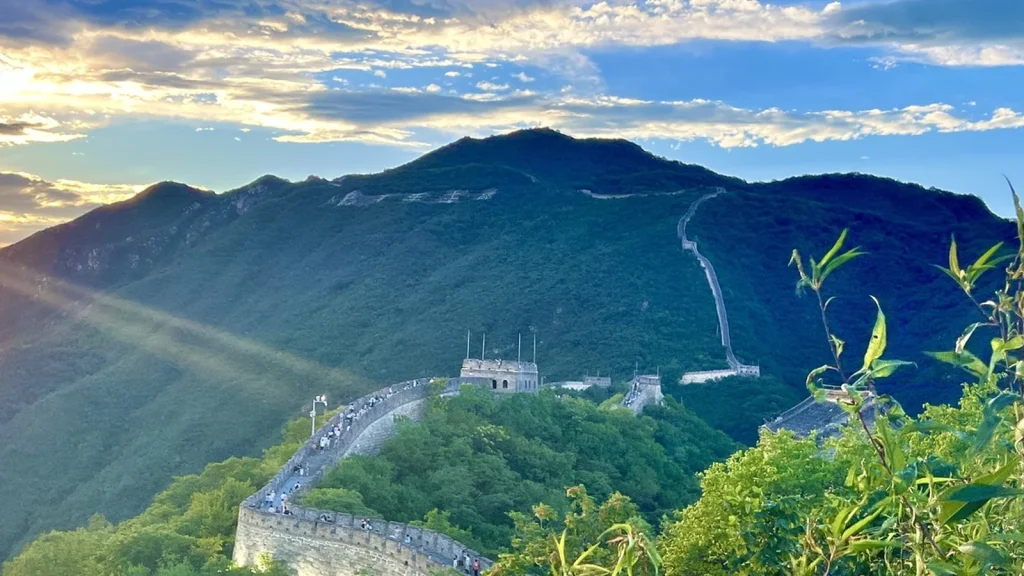
Is a Beijing airport layover to Mutianyu practical?
It can be practical from PEK if your connection is long, your arrival is on time, you can legally leave the airport, and you are willing to use a direct private transfer. Mutianyu is in Huairou District, northeast of central Beijing, which makes it a better fit for PEK than many downtown attractions. The drive still depends on traffic, weather, and holiday pressure, so you should treat any timing estimate as a range, not a promise.
From PKX, the plan becomes much harder. Daxing Airport is far south of central Beijing, while Mutianyu is north of the city. That means the route must cross or skirt a large urban area before reaching the mountains. For most travelers, PKX-to-Mutianyu only makes sense with an unusually long layover, no checked baggage complications, and a very conservative return buffer.
PEK or PKX: which airport works better?
Beijing Capital International Airport (PEK) is the airport to consider first. It is on the northeast side of Beijing, closer to the road corridor toward Huairou and Mutianyu. If you have enough time to clear immigration, meet a driver, ride to Mutianyu, spend a focused period on the Wall, and return for your next flight, PEK can work well.
Beijing Daxing International Airport (PKX) is less suitable for this specific plan. Daxing is an excellent airport, but its location makes a Mutianyu layover a long cross-city movement. For PKX, a hotel rest, airport services, or a closer urban route may be safer unless your stopover is long enough to absorb delays without stress.
How much layover time do you really need?
Do not count only the driving time. A realistic layover plan must include arrival taxiing, immigration, baggage decisions, finding your driver, road traffic, scenic-area entry, the internal transfer to the Wall access point, time on the Wall, the return drive, airline check-in requirements, security, and possible extra screening before an international departure.
For a PEK layover, think in three bands. If you have only a short connection, do not leave the airport. If you have a medium connection, Mutianyu is still risky because one delay can remove your actual Wall time. If you have a long connection or a planned overnight stop, Mutianyu becomes realistic. For PKX, move everything one risk level higher because the road distance is less forgiving.
The safest version is simple: arrive, clear entry formalities, take a prearranged car to Mutianyu, use the most efficient ascent option that is operating that day, enjoy one focused Wall section, return early, and re-enter the airport with plenty of buffer. This is not the day to add the Forbidden City, a hutong walk, and a restaurant stop unless you have a true stopover, not just a connection.
Immigration and visa-free transit checks
Before planning any layover sightseeing, confirm whether you can leave the airport. The National Immigration Administration explains separate 24-hour and 240-hour visa-free transit policies. The 24-hour policy may still require a temporary entry permit if you need to leave the restricted port area. The 240-hour policy applies only to eligible nationals, eligible ports and routes, valid international travel documents, and onward tickets with confirmed seats and departure dates.
In practical terms, do not build the trip around an assumption that entry will be automatic. Your passport, itinerary, onward destination, airline documentation, and port handling all matter. If your airline, immigration officer, or airport process says you cannot leave, the Great Wall plan ends there. This is why a long buffer is more important than a perfectly drawn itinerary.

Why Mutianyu is the best Great Wall choice for many layovers
Mutianyu is not the closest Great Wall section to every point in Beijing, but it is one of the best-balanced sections for foreign visitors. The Wall is restored, the mountain scenery is strong, visitor facilities are better than at many wild sections, and the route can be kept simple. For a layover, that balance matters more than chasing the most dramatic or least crowded section.
Badaling can be efficient by rail from central Beijing, but it often feels more crowded and is less convenient from PEK if you are not already in the city. Jinshanling and Simatai are excellent scenic choices, but they are farther and better for travelers who can dedicate a full day or overnight plan. Jiankou is not appropriate for a layover because it is rugged, slower, and more risk-sensitive.
If you are still choosing a section, compare this plan with our Mutianyu transport guide, Badaling vs. Mutianyu comparison, and guide to Great Wall sections near Beijing.
Best route style for a layover
Use a private car or prearranged transfer if you are serious about making the trip. Public buses, tourist shuttles, and subway connections can be useful for normal Beijing sightseeing days, but they add waiting time and uncertainty that do not belong in an airport connection. The official Mutianyu transport page lists public and tourist-line options, but a layover requires direct control over departure and return timing.
Ask the driver or service to build the plan around your flight, not around maximum sightseeing time. The return-to-airport time is the anchor. If the return buffer looks uncomfortable before you even leave PEK or PKX, cancel the Wall visit and keep the airport day easy.

Suggested layover visit at Mutianyu
For a layover, avoid complicated hiking goals. A good plan is to enter the scenic area, go up to a restored section, walk between a small number of watchtowers, take photos, and return before fatigue or timing pressure builds. If cable car, chairlift, or other ascent options are affected by weather, maintenance, or queues, adjust on the spot. The point is to experience the Great Wall clearly, not to complete a long route.
If you are traveling with children or older visitors, keep the route even simpler. Mutianyu is one of the better sections for families and mixed-ability groups, but airport fatigue changes the calculation. See our Mutianyu with kids guide and Great Wall accessibility guide before making the plan too ambitious.
Before-you-go checklist
- Confirm your visa-free transit or visa status using official channels before the flight.
- Check whether you need to collect and re-check baggage.
- Keep your onward boarding, hotel, and driver details easy to show.
- Use a direct transfer, not public transport, for a true layover.
- Check Mutianyu official opening, ticketing, and route notices before leaving the airport.
- Carry a power bank, passport, payment method, mobile data, and weather-appropriate layers.
- Return to the airport early enough for international departure procedures.
For packing and communication details, read what to pack for a Great Wall trip and how to get internet in China for tourists.
Who should do this trip?
Choose a Beijing airport layover to Mutianyu if you have a long buffer, you are comfortable with immigration uncertainty, you can afford direct transport, and you mainly want one high-quality Great Wall experience. Skip it if your layover is short, your next flight is critical, your luggage situation is unclear, the weather is poor, or your group includes travelers who will be stressed by a tight schedule.
The best layover Great Wall trip feels controlled. You see the Wall, take in the mountain scenery, and return with time to spare. If the plan only works when every step goes perfectly, it is not a good airport layover plan.