
Dongzhimen is the classic public-transport starting point for travelers trying to reach Mutianyu Great Wall from Beijing. The route is widely mentioned because it connects the city center with Huairou by express bus, then continues toward the scenic area by local bus, tourist line, taxi, or ride-hailing. It can work, but it is not the easiest route for every foreign visitor.
This guide explains how to think about the Dongzhimen to Mutianyu Great Wall route, when the 916 Express plan is worth using, what can go wrong at the Huairou transfer, and when a direct car is a better choice. It is more specific than a general Beijing to Mutianyu transport article because the starting point, transfer logic, and return risk are different.
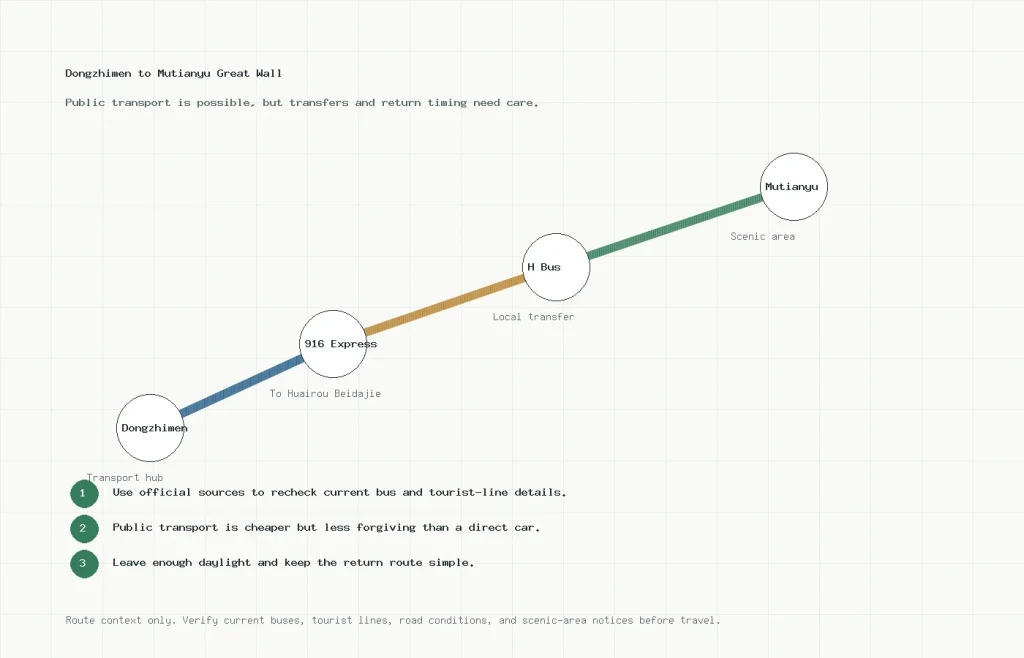
Quick Planning Snapshot
- Best for: budget travelers who are comfortable with Beijing buses, Chinese stop names, and flexible timing.
- Official public route idea: Dongzhimen Public Transport Hub to Huairou Beidajie by 916 Express, then local bus toward Mutianyu Scenic Area.
- Biggest advantage: cheaper than a private transfer and useful if you start near Dongzhimen, Sanlitun, or the Airport Express area.
- Biggest risk: the Huairou transfer and return journey can be confusing, slow, or poorly timed for first-time visitors.
- Better alternative for many visitors: a direct car from your hotel or a verified tourist line if current times and pickup points fit your plan.
What the Official Route Says
The Beijing government English page for Mutianyu says to take Express Bus 916 from Dongzhimen Public Transport Hub to Huairou Beidajie, then transfer to a local bus such as H23, H3, or H71 and get off at Mutianyujingqu. The Mutianyu official site gives similar public-transport advice, listing Bus 916 from Dongzhimen to Huairou Beidajie and then local buses such as H7, H23, H24, H35, or H36. It also lists tourist-line options from Dongzhimen and other Beijing pickup points.
Those official references are useful, but they should not be read as a promise that every bus will be convenient at the exact time you travel. Local bus frequency, holiday operations, weather, road traffic, and return demand can all affect the day. Treat the official route as the baseline, then check current details before you leave.
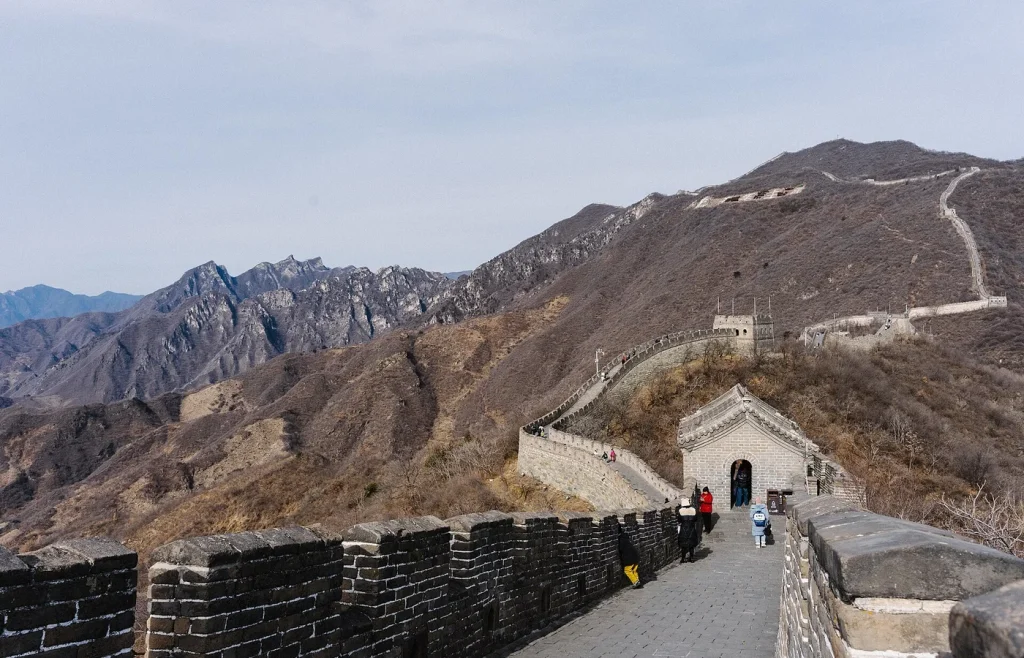
Step 1: Start at Dongzhimen
Dongzhimen is a major transport area in northeast central Beijing, connected with subway lines, the Airport Express, and bus facilities. If you are staying around Dongzhimen, Sanlitun, Workers’ Stadium, Chaoyangmen, or the northeast side of the city, this starting point can be convenient. If you are staying near Wangfujing or Qianmen, compare the dedicated Wangfujing to Mutianyu and Qianmen to Mutianyu guides before assuming Dongzhimen is best.
Before the day of travel, save the Chinese names 东直门交通枢纽, 怀柔北大街, and 慕田峪景区. Screenshots help if your mobile signal drops or if a map app shows several similar bus stops. Arrive early enough to find the correct bus area without rushing, especially if this is your first Beijing bus trip.
Step 2: 916 Express to Huairou
The first long leg is the 916 Express from Dongzhimen toward Huairou. This part is usually the easiest to understand because it is a well-known route. The challenge is not simply boarding the first bus. The challenge is making sure you get off at the right transfer area, still have enough daylight, and know how you will continue from Huairou toward Mutianyu.
Do not plan this like a subway transfer. Buses face road traffic, crowding, stop confusion, and different levels of English support. Keep the route open in your map app, watch your location as you approach Huairou, and ask for help early if the stop names become unclear. If your group includes children, older travelers, or anyone who dislikes uncertainty, this is the moment where a direct car starts to look more attractive.
Step 3: Transfer Toward Mutianyu Scenic Area
After reaching Huairou Beidajie, the official route points to local buses toward Mutianyu Scenic Area. Depending on the day, a local bus, tourist line, taxi, or ride-hailing car may be the practical choice. The important rule is simple: decide the return before you go up the Wall. If you only think about reaching Mutianyu and ignore the way back, the afternoon can become stressful.
At Mutianyu, you still need to handle scenic-area ticketing, shuttle movement, and your choice of cable car, chairlift, toboggan, or walking route. Public transport saves money, but it does not remove the time cost inside the scenic area. If your goal is a relaxed first Wall visit, keep the walking plan moderate and leave enough energy for the return transfer.
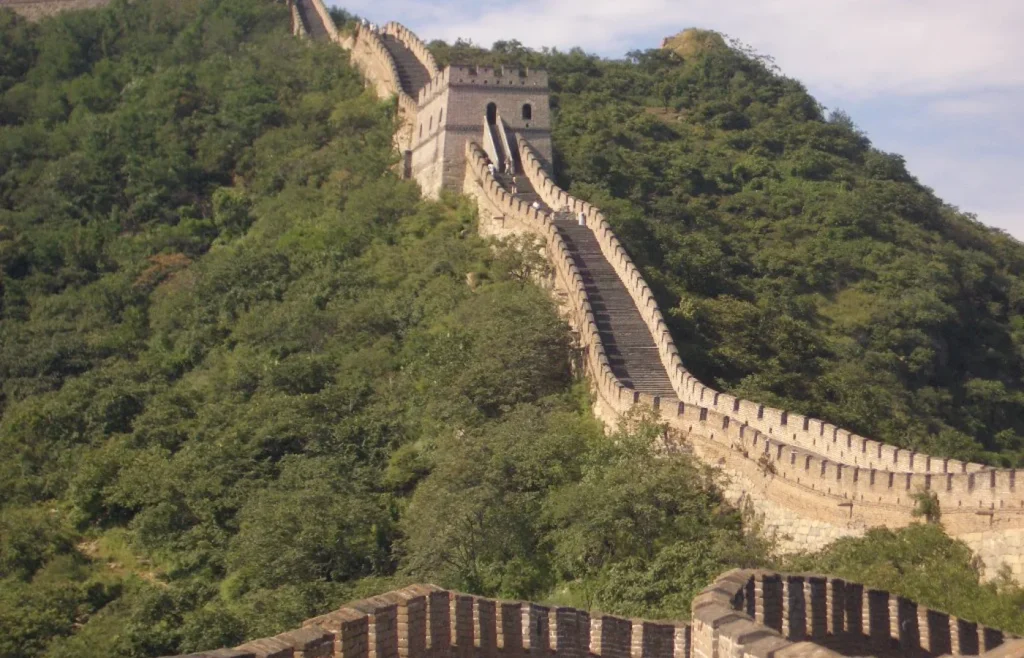
Public Bus, Tourist Line, or Direct Car?
Choose the public bus route if you are budget-focused, patient, and comfortable with local transport. It is a real route and can be satisfying if you like figuring out the city. Choose a tourist line if the current pickup point, departure time, and return time match your schedule. Choose a direct car if you value certainty, have a group, are traveling with luggage, or want to avoid the Huairou transfer.
For most first-time foreign visitors, the direct car is often the smoother option, while Dongzhimen public transport is the budget option. That does not make the bus route bad. It means the route should be chosen honestly. If saving money is the priority, use public transport. If protecting the day is the priority, simplify the transfers.
Timing and Return Advice
Start early. A late morning departure from Dongzhimen can leave too little time for buses, ticketing, shuttle movement, walking on the Wall, and the return. Weather also matters. Rain, snow, heat, or strong wind can make the Wall more tiring and slow down transport. If the forecast is poor, read the Beijing to Great Wall transport guide and consider a simpler route or a different day.
On the return, do not wait until the last possible local bus or assume ride-hailing will always be instant in the mountains. Leave the scenic area with daylight and buffer. If you are trying to catch a flight, train, dinner reservation, or evening show, do not rely on the full public route unless you have checked current return details carefully.
Before-You-Go Checklist
- Check the current Mutianyu official transportation page before travel.
- Save Chinese names: 东直门交通枢纽, 怀柔北大街, 慕田峪景区.
- Screenshot route details, bus stop names, and return options.
- Bring water, snacks, sun protection, layers, and shoes with grip; use the Great Wall packing guide if unsure.
- Keep cashless payment ready, but do not depend on only one payment method.
- Plan the return before you enter the scenic area.
- If the route feels too uncertain, compare other Great Wall sections near Beijing or use a direct car to Mutianyu.
References and Current Checks
For current public-transport and scenic-area context, check Beijing’s official English page for Mutianyu Great Wall, the Mutianyu official page on recommended transportation routes, and the Mutianyu one-day-trip page that lists Dongzhimen public transport and tourist-shuttle options. Image-license pages: Dongzhimen Station Exit H, Mutianyu section view, and Mutianyu walking route.